

Frankfurt, 21 January 2026 – Prof. Jürgen Fleischer, Head of the Institute for Production Technology (wbk) at the Karlsruhe Institute of Technology (KIT), is the new President of the WGP (Scientific Society for Production Technology). His goal for his two-year term is to work with his colleagues at the WGP to strengthen the competitiveness of the German manufacturing industry: ‘Our domain knowledge gives us a unique selling point, and we should capitalise on this asset in the face of global competitive pressure.’ Fleischer, who replaced Prof. Michael Zäh from iwb Munich on 1 January 2026 as scheduled, worked in industry for eleven years before joining the University of Karlsruhe. ‘Not only do we have concentrated scientific expertise across the entire spectrum of manufacturing technology, but we also bring a wealth of industrial experience to the table. We understand the challenges facing manufacturing companies, and we can and want to help them.’
More than 70 leading scientists have joined forces in the WGP. ‘Manufacturing companies can take advantage of the WGP’s unique expertise in all areas of production technology – including future topics such as quantum technologies – and work with us to develop tailor-made solutions for their specific needs,’ reports Fleischer. Working together, sustainable technologies can be developed and competitive production systems designed. ‘Germany’s in-depth understanding of manufacturing systems and its ability to deliver innovative developments for the global market give us a head start that we must exploit more urgently than ever in view of the declining competitiveness of German industry,’ warns the new WGP President. The challenges posed by new technologies are particularly important for small and medium-sized enterprises in order to make themselves fit for the future. ‘The WGP institutes offer them excellent opportunities for cooperation in this regard.’
WGP is working on tomorrow’s production
The members’ 46 internationally renowned university and Fraunhofer institutes have state-of-the-art laboratories in their respective fields, which can be used as real-world testing grounds. This allows new approaches to be developed in areas such as digitalisation, automation and sustainability. The Karlsruhe team, for example, developed a 3D printer for fibre composite components for a medium-sized company. They also supported another company in introducing AI-supported optical quality control for bent parts that are stamped every second. The researchers also collaborate with consortia of larger companies and have created, for example, the world’s first highly flexible production plant for battery cells (AgiloBat).
Artificial intelligence in particular will radically change production. ‘But small and medium-sized companies in particular – the backbone of our prosperity – often do not have the necessary human and financial resources for the transformation,’ the Karlsruhe scientist points out. The WGP therefore consolidated the ProKI project, funded by the Federal Ministry of Education and Research, under its umbrella in January 2025 and has since been offering workshops, consultations, seminars and demonstrators – low-threshold support that benefits everyone.
Learning speed from the Chinese
For over ten years, Fleischer has also been an advisory professor at Tongji University in Shanghai, where he has established a technology centre for advanced manufacturing. ‘China is and will remain an important market for us,’ he emphasises. ‘I used to be there to support German companies, among other things. Today, I am there to learn from the Chinese how to advance mechanical and plant engineering at such an astonishing speed and efficiency. We have to learn from them if we don’t want to fall behind in the global market.’
Faster transfer of innovative solutions into business practice has always been a concern of professors, especially as new technologies are developing rapidly. Ten years ago, Fleischer launched the WGP Production Academy, a modular continuing education programme for practitioners who want to bring themselves up to speed with the latest technology. The modules can be individually combined to create a tailor-made programme. ‘Manufacturing companies that want to stay at the forefront must use innovative manufacturing processes to exploit the immense potential of new technologies,’ says Fleischer. ‘Those who do not develop further today will no longer be competitive tomorrow.’
Further Information:
Download:
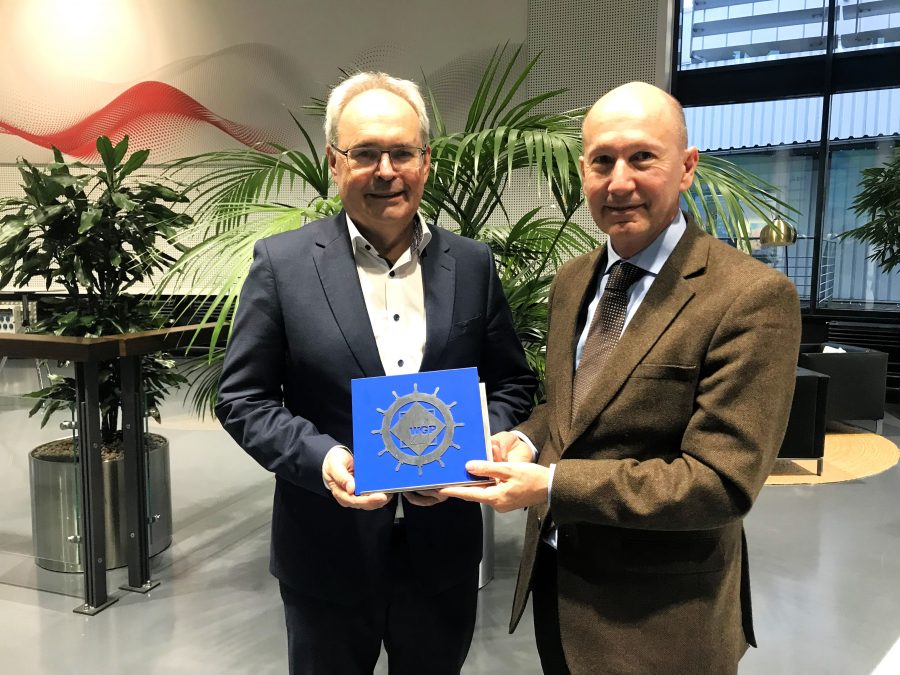
Image 1: Handover of the WGP helm from Prof. Michael Zäh to Prof. Jürgen Fleischer, Head of wbk at KIT, at the WGP Autumn Conference in Friedberg/Hesse, 6 November 2025 (from left to right: Prof. Jürgen Fleischer, Prof. Michael Zäh); Source: Tobias Kaufmann, RWTH Aachen University
Image 2: Prof. Jürgen Fleischer; Source: wbk Karlsruhe
Image 3: Prof. Michael Zäh, WGP Vice President; Head of the iwb Munich; Source: Sebastian Kissel